How to Audit Seedling Logo Certificates and Reduce 2026 Regulatory Risk - The Importer’s Technical Guide
Introduction: Why “Logo-Level” Compliance Is a Hidden Business Risk
In the 2026 global trade environment, terms like “compostable” and “biodegradable” are no longer marketing language. They represent legal, technical, and financial obligations.
For importers and procurement managers, a certificate is not a decorative document—it is a risk shield against customs detention, shipment rejection, and greenwashing litigation.
Based on real certificate reviews conducted during supplier audits and pre-shipment compliance checks, one recurring and high-risk mistake consistently emerges: relying solely on the presence of the Seedling Logo without examining the technical scope of the certificate itself.
This surface-level approach leaves brands exposed. True compliance requires moving beyond the logo and performing a technical audit of the certification document.
Core Principle: Compostability Is Not Universal
In certification reviews, we regularly see cases where a valid compostability certificate exists—but does not apply to the actual product being shipped.
The reason is simple:
Compostability is not an on/off property of a material.
It is the result of a specific combination:
Material composition + product geometry + certified composting conditions
A certificate validates one exact product configuration under defined conditions.
If your purchased product differs in composition, thickness, or structure, the certificate may no longer apply—even if the same logo is printed on the bag.
Quick Glossary: Key Terms Explained
• EN 13432
The core European standard for industrially compostable packaging. It defines strict pass/fail criteria for biodegradation, physical disintegration, and ecotoxicity within a controlled industrial composting environment.
• ASTM D6400
The primary North American standard for compostable plastics, required for access to the U.S. and Canadian markets.
• Seedling Logo
A visual mark administered by European Bioplastics indicating certification against EN 13432. The logo itself contains no technical parameters.
• DIN CERTCO
A globally recognized certification body that evaluates and certifies compostable and bio-based products against standards such as EN 13432 and ASTM D6400.
• DAkkS
Germany’s national accreditation body. Its mark confirms that the certification body operates under formal accreditation in accordance with EU Regulation (EC) No. 765/2008.
Case Study: Auditing a DIN CERTCO Certificate in Practice
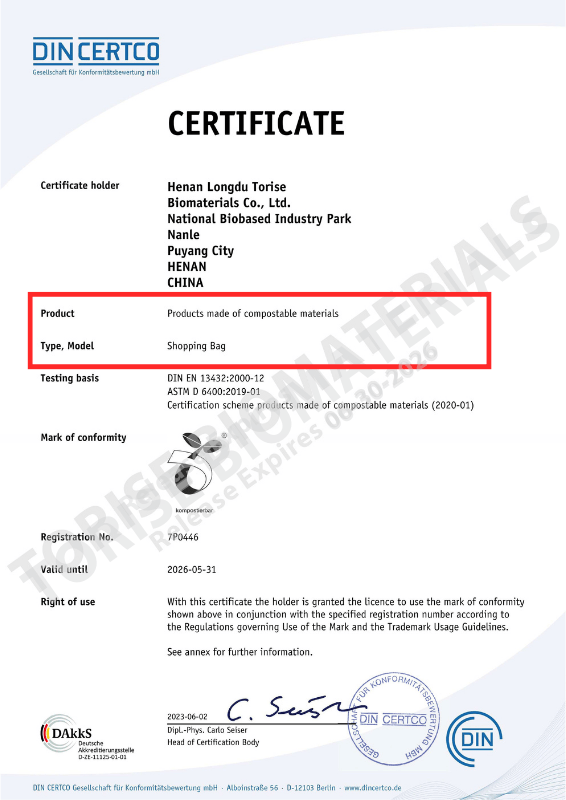
Let’s apply this framework to a publicly verifiable DIN CERTCO certificate issued to Henan Longdu Torise Biomaterials Co., Ltd. (Registration No. 7P0446), which can be independently checked in the DIN CERTCO online database.
About the Certificate Holder: Torise Biomaterials is a professional manufacturer focused on compostable and bio-based materials. The company holds multiple international compostability certifications for its finished products, including the shopping bag under certificate 7P0446 discussed here. This makes its certificate a relevant and practical example for importers to study.
This certificate can be independently checked in the DIN CERTCO online database and serves as an excellent example of how technical certificate auditing works in real import compliance workflows.
Audit Point 1: Finished Product vs. Resin — A Non-Negotiable Distinction
The certificate explicitly lists the product as “Shopping Bag.”
Why this matters
Many suppliers present certificates for the base resin only. While this confirms that the polymer is compostable in principle, it does not certify the finished article.
A finished product certificate confirms that the entire item—including:
• inks and printing layers
• additives and processing aids
• color masterbatch
• product structure and geometry
has been tested as a complete system.
Importer risk
If you import finished bags supported only by a resin certificate, the compliance of the final product remains unverified. In practice, this is one of the most common reasons for shipment rejection during compliance reviews.
Action
Always ensure the “Product” field on the certificate explicitly matches what you are purchasing (e.g., shopping bag, garbage bag, cutlery), not just the raw material.
Audit Point 2: Verifying Market-Specific Standard Compliance
Asset
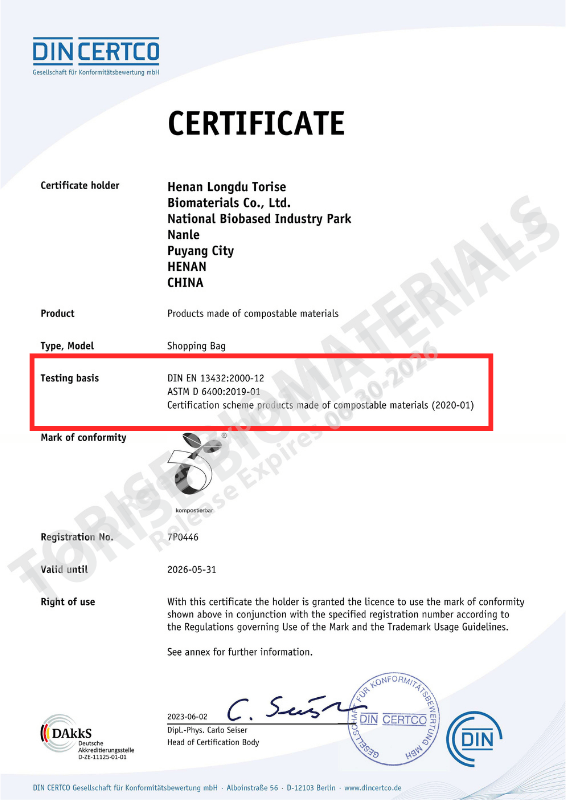
This certificate is tested against both:
1. DIN EN 13432 (Europe)
2. ASTM D6400 (North America)
Why this matters
This is not a minor technical detail—it is a supply-chain advantage.
Dual certification means the same product configuration has demonstrated compliance with:
• EU industrial composting requirements
• U.S. and Canadian compostability criteria
For importers, this functions as a regulatory passport, enabling:
• simplified sourcing
• reduced documentation friction
• lower compliance risk across multiple markets
As compostability regulations tighten and diverge regionally after 2026, this flexibility becomes increasingly valuable.
Audit Point 3: Maximum Certified Thickness — The Most Common Compliance Failure
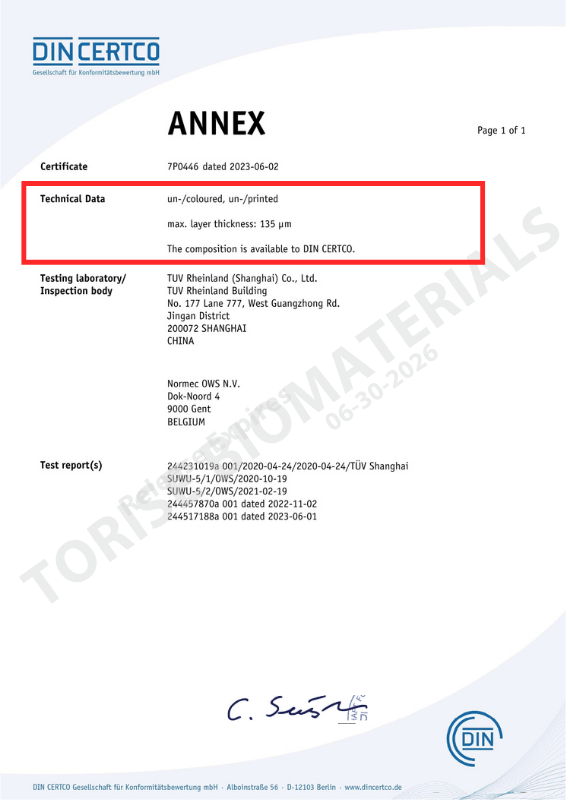
Every valid compostability certificate includes a maximum certified thickness, typically listed in the annex.
The science behind the limit
Industrial composting relies on microbial access and penetration. Thickness directly controls the rate of disintegration and biodegradation. If a product is too thick, it may not fully break down within the required timeframe, leaving residual fragments in the compost.
Critical importer risk
If your ordered bags exceed the certified thickness—even if the material formulation is identical—the certificate no longer applies.
This mismatch is one of the most frequent causes of “unexpected” non-compliance.
Action
• Always request the full certificate annex
• Cross-check the maximum certified thickness against your product specification
• Treat thickness verification as a mandatory compliance step, not a formality
A Practical Verification Protocol Used in Import Compliance Reviews
Technical scope alone is not sufficient. Document authenticity must also be verified.
1. Accreditation check
Confirm the presence of the DAkkS accreditation mark to ensure the certification body operates under formal national accreditation.
2. Database verification
Use the registration number (e.g., 7P0446) to verify the certificate’s status directly in the certifier’s public online database. Confirm that the listed licensee matches your contracted supplier exactly. Click here for official certificate verification.
3. Expiration control
Compostability certificates have defined validity periods. Shipping under an expired certificate is a predictable rejection risk in current and future regulatory environments.
A Simple Checklist for Non-Technical Buyers
If you are new to compostability certification audits, ask your supplier these four questions—and require documented proof:
1. Market scope
Does the certificate list the statutory standards required for your product’s target market/region?
2. Certification scope
Is the certificate issued for the finished product I am buying?
3. Technical limits
What is the maximum certified thickness? Can you provide the full annex?
4. Validity and verification
Is the certificate current and unexpired? What is the registration number for independent verification?
Why This Guide Matters for Importers in 2026
As compostability claims face increasing scrutiny from customs authorities, market surveillance bodies, and brand compliance teams, certification reviews are shifting from simple document checks to technical scope audits.
Importers are no longer evaluated on whether a certificate exists—but on whether it correctly applies to the shipped product.
This guide reflects how compostability certificates are reviewed in real procurement and compliance workflows, helping buyers identify risks before goods move across borders.
Conclusion: Turn Compliance into a Competitive Advantage
In sustainable packaging, the lowest unit price often hides the highest risk—embedded in certification gaps that surface only when shipments are already in transit.
By mastering the audit of Seedling Logo certificates, importers move from passive buyers to active risk managers. You gain the ability to:
• distinguish resin certification from finished product approval
• leverage dual-market certification strategically
• eliminate thickness-related compliance failures
• verify authenticity before shipments move
In 2026, compliance literacy is no longer optional—it is your competitive moat.