Custom Compostable Dog Poop Bags: A B2B Guide to Private Label Bags
B2B BUYING GUIDE
Custom Compostable Dog Poop Bags: A B2B Guide to Private Label Bags, Branded Dispensers & Manufacturers
If you are sourcing dog waste bags for a pet brand, retail chain, distributor, subscription box, or e-commerce business, the product itself is only part of the decision. The real sourcing questions involve customization, dispenser compatibility, certifications, MOQ, quality consistency, packaging, cost, and long-term supply reliability.
What Are Custom Dog Poop Bags?
Custom dog poop bags are dog waste bags manufactured according to a buyer's specified product and branding requirements rather than supplied as a standard off-the-shelf product.
Customization can cover both the bag itself and the retail system around it.
| Customization | Typical B2B Options |
|---|---|
| Bag size | Standard or custom dimensions |
| Thickness | Selected according to strength and positioning |
| Bag structure | Flat, wave-top, handle, drawstring and other formats |
| Film color | Green, black, white or custom color |
| Printing | Logo, artwork, brand message or instructions |
| Bags per roll | Standard or custom roll count |
| Packaging | Box, sleeve, pouch or bulk carton |
| Dispenser | Standard or branded dispenser |
| Certifications | Market-specific compostability certifications |
These specifications are connected. For example, changing film thickness can affect roll diameter, while changing bags per roll can affect retail packaging dimensions. A good manufacturer therefore evaluates the complete product system, rather than quoting only a price per bag.
Why Are Brands Moving to Private Label Dog Poop Bags?
For many pet brands, dog waste bags are a practical way to expand an existing product portfolio. A brand may already sell dog collars, leashes, toys, grooming products, pet food accessories or other walking products.
Adding private label dog poop bags creates a consumable product that customers may purchase repeatedly while keeping the product under the brand's own identity.
Private Label Can Include
- Product branding: logo, colors, artwork, messaging and positioning.
- Retail packaging: boxes, sleeves, labels, inserts, barcodes and multipack configurations.
- Product specifications: size, thickness, color, roll count, bag structure and other requirements.
- Accessory integration: a branded dispenser supplied with refill rolls to create a complete dog-walking product.
Custom Dog Poop Bags vs. Private Label Dog Poop Bags
These terms are often used interchangeably, but there is a useful purchasing distinction.
Custom dog poop bags focus primarily on the physical product: dimensions, thickness, color, printing, structure and roll configuration.
Private label dog poop bags describe a broader branded program, potentially including the bag, printed roll, retail packaging and dispenser.
What Should You Customize on a Dog Poop Bag?
Not every customization adds meaningful value. For B2B buyers, prioritize the elements that influence product performance, retail positioning and user experience.
1. Bag Size
Size should match the intended customer and dog population. Larger bags can provide additional coverage for large dogs or customers who prefer more room when tying and disposing of waste.
When comparing suppliers, do not compare only the listed bag size. Ask for the actual bag width, bag length, usable opening, bottom seal dimensions and film thickness.
2. Film Thickness
Thickness is closely related to product positioning. A thinner film can reduce material usage and packaging volume, but the bag still needs sufficient strength for its intended application.
Instead of asking, “What is your thickest bag?”, ask: “What thickness do you recommend for our target bag size, dog size and retail positioning?”
3. Bag Structure
Different structures create different user experiences. Common formats include flat-top, wave-top, handle-tie, drawstring and roll bags for standard dispensers.
For premium pet brands, handle or drawstring formats can provide stronger differentiation because they can make tying and carrying the filled bag easier.
Branded Dog Poop Bag Dispenser: More Than an Accessory
A branded dog poop bag dispenser can be an important part of a private label program. The dispenser stays with the customer during every dog walk, making it a visible part of the product experience.
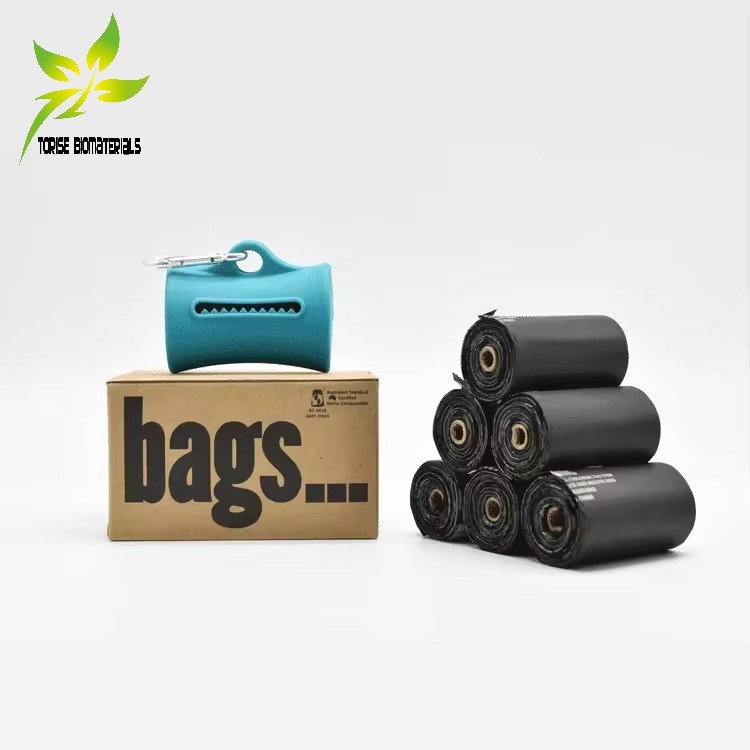
A complete retail product can therefore become:
Dog Poop Bags + Branded Dispenser + Retail Packaging
1. Roll Compatibility
The dispenser must work with the selected roll. Check roll width, roll diameter, core diameter, bag count and perforation position.
2. Attachment System
Common options include carabiner clips, leash clips, belt attachments and bag-loop attachments. For everyday dog walking, a secure and easy-to-use attachment is generally more important than unnecessary complexity.
3. Branding Area
If the dispenser is part of the marketing strategy, confirm the printable area, logo size, printing method, color matching requirements and artwork format.
4. Retail Presentation
Develop the dispenser together with the packaging. For example, a retail set could combine one dispenser with two or four refill rolls rather than treating the dispenser as a separate accessory.
How to Choose a Reliable Poop Bag Manufacturer
Searching for poop bag manufacturers will return many suppliers, but not every supplier is suitable for a long-term private label program.
Evaluate the supplier across manufacturing capability, materials, certification, customization, quality control, commercial terms and repeat-order support.
1. Manufacturing Capability
Ask whether the company actually manufactures the bags or primarily acts as a trading company. For larger programs, manufacturing capability can affect production consistency, lead time, quality control, customization, cost and repeat-order stability.
2. Material Specification
Do not accept only descriptions such as “eco-friendly” or “biodegradable.” Ask for the actual material formulation and the conditions under which the product is intended to compost or biodegrade.
Common material systems for compostable dog waste bags include combinations of PBAT, PLA and starch-based materials. The exact formulation should be selected according to required performance and target market.
3. Certification
If the product is marketed as compostable, certification should be part of the purchasing decision. Depending on the target market, buyers may encounter standards and certification systems such as:
- EN 13432
- ASTM D6400
- AS 4736
- AS 5810
- OK compost INDUSTRIAL
- OK compost HOME
- BPI
The important question is not simply whether a factory has a certificate, but whether the certification applies to the actual product specification being purchased.
What Does a Good Custom Dog Poop Bag Specification Look Like?
Before requesting quotations, prepare a basic specification sheet. This makes supplier quotations easier to compare and reduces misunderstandings during sampling and production.
| Item | Example Requirement |
|---|---|
| Product | Custom compostable dog poop bags |
| Target market | USA / Europe / Australia / Other |
| Bag size | Standard or custom |
| Thickness | To be recommended based on application |
| Material | Compostable / other specified formulation |
| Bag color | Brand color |
| Printing | Custom logo / artwork |
| Bags per roll | 15 / 20 / 30 or customized |
| Dispenser | Required / Not required; branded if needed |
| Retail packaging | Box / sleeve / pouch / bulk |
| Certification | Market-specific |
| Estimated quantity | Initial order + annual forecast |
A Better Way to Request a Quote
Instead of sending “Please quote 100,000 dog poop bags,” provide the manufacturer with enough information to understand the complete project.
Recommended RFQ: product, target market, bag size, thickness, material, color, printing, bags per roll, dispenser requirements, packaging, certification, estimated order quantity, annual forecast and target delivery date.
Why the Cheapest Quote May Not Be the Cheapest Product
A low unit price can be misleading. One supplier may quote a lower price because the product has a smaller bag, lower thickness, fewer bags per roll, lower-cost packaging or different material requirements.
Another supplier may have a higher unit price but provide larger usable bags, more consistent thickness, stronger seals, required certification, better packaging or a more suitable dispenser system.
Total Landed Cost = Product Cost + Packaging + Tooling/Printing + Freight + Duties/Import Costs
For a private label project, also consider the cost of rejected products, delayed shipments, packaging changes and inconsistent repeat orders.
Quality Control: What Should Buyers Test?
Dog poop bags are a simple product, but small manufacturing problems can create a poor customer experience. A B2B inspection should include several practical checks.
- Leak resistance: the bag should retain waste without leakage during normal use.
- Seal strength: bottom and side seals should remain intact under the intended load.
- Tear resistance: the film should not tear easily during normal handling.
- Easy separation: roll bags should separate cleanly along the perforation.
- Opening performance: bags should be reasonably easy to open during outdoor use.
- Print quality: inspect logo clarity, color consistency, registration, adhesion and print position.
- Roll consistency: check roll diameter, bag count, perforation alignment and core dimensions.
How the Private Label Process Should Work
- Define the market: target country, sales channel, customer type and sustainability claims.
- Define the product: size, thickness, structure, color, roll count and dispenser requirements.
- Confirm certification: identify relevant market-specific requirements.
- Develop artwork: bag artwork, logo, retail packaging, barcode and instructions.
- Produce samples: evaluate strength, sealing, opening, printing, packaging and dispenser compatibility.
- Approve the specification: use the approved sample as the production reference.
- Mass production: manufacture according to the approved material, dimensions, thickness, printing, roll count and packaging.
- Pre-shipment inspection: inspect finished goods against the approved specification.
- Repeat orders: maintain the same controlled specification across future production batches.
What MOQ Should You Expect for Custom Dog Poop Bags?
MOQ varies depending on the product and customization requirements. There is no universal MOQ for all private label dog poop bags.
Custom film colors, printing, special structures, custom dispensers, retail packaging, multiple SKUs and special certification requirements can all affect MOQ.
For a new project, ask the manufacturer to quote MOQ by SKU rather than assuming one MOQ applies to the complete product range.
Custom Dog Poop Bags for Different B2B Buyers
Pet Brands
Pet brands usually prioritize strong brand identity, custom printing, premium packaging, consistent quality and repeat-order capability. A branded dispenser can help create a complete dog-walking product line.
Pet Retailers
Retailers often care about shelf presentation, barcode-ready packaging, retail price positioning, pack size, product differentiation and reliable replenishment.
Distributors
Distributors typically focus on factory pricing, MOQ, container utilization, product consistency, multiple SKU management, lead time and documentation.
E-Commerce Brands
E-commerce brands often need strong visual branding, custom packaging, compact shipping dimensions, product differentiation and stable repeat supply.
Should You Choose Standard or Fully Custom Dog Poop Bags?
Choose a Standard Specification When:
- You are testing a new market.
- Your initial volume is limited.
- Speed is more important than differentiation.
- You want to reduce development costs.
- You are validating customer demand.
Choose a Fully Customized Specification When:
- You already have an established pet brand.
- You need stronger product differentiation.
- Your retail packaging is brand-specific.
- You require specific certifications.
- You expect recurring orders.
For many brands, a practical approach is standard proven bag structure + custom branding + custom packaging. This provides differentiation without unnecessarily increasing technical complexity.
Why Work With Torise for Custom Dog Poop Bags?
Torise Biomaterials provides custom compostable pet waste bag manufacturing for brands, retailers, distributors and other B2B buyers.
The product program can support custom specifications including bag size, thickness, color, printing, packaging and dispenser solutions. Material options include PBAT, PLA and starch-based formulations, depending on the required product specification.
For private label programs, the manufacturing scope can extend beyond the bag itself:
Material Selection → Film Production → Bag Making → Printing → Roll Production → Retail Packaging → Dispenser → Final Packing
An integrated approach can reduce the need for buyers to coordinate multiple suppliers for one product line while keeping the product specification more consistent.
8 Mistakes to Avoid When Buying Custom Dog Poop Bags
- Comparing only unit price. A cheaper bag may have different dimensions, thickness, material or packaging.
- Using “biodegradable” as the only sustainability requirement. Ask what the claim means and which standard or certification supports it.
- Forgetting dispenser compatibility. A custom roll that does not fit the dispenser creates unnecessary customer complaints.
- Customizing too many things at once. Every additional SKU increases inventory and production complexity.
- Skipping pre-production samples. Digital artwork cannot confirm bag strength, seal quality or dispenser compatibility.
- Not defining the approved sample. Without a controlled reference, repeat orders may gradually change.
- Ignoring packaging dimensions. The bag, roll, dispenser and retail box should be designed as one system.
- Choosing a supplier without considering repeat orders. The real test is whether the manufacturer can reproduce the same product consistently over time.
Frequently Asked Questions
What are custom dog poop bags?
Custom dog poop bags are manufactured according to a buyer's specified dimensions, thickness, color, printing, roll configuration, packaging or other requirements. They are commonly used by pet brands, retailers, distributors and e-commerce businesses.
Can I put my logo on dog poop bags?
Yes. Custom printing can be used to add a company logo, brand graphics, product information or other artwork. Printing options depend on the bag material, color and production requirements.
What are private label dog poop bags?
Private label dog poop bags are produced by a manufacturer and sold under the buyer's own brand. A private label project can include custom bags, printed rolls, retail packaging and branded dispensers.
Can I customize a dog poop bag dispenser?
Yes. Depending on the dispenser design, the dispenser can be customized with a brand logo, color, artwork or packaging. It should be developed together with the refill roll to ensure compatibility.
What certifications should I look for in compostable dog poop bags?
Depending on the target market, buyers may look for certification systems and standards such as EN 13432, ASTM D6400/BPI, AS 4736, AS 5810, OK compost INDUSTRIAL or OK compost HOME. Verify that the certification applies to the actual product specification being purchased.
What is the MOQ for custom dog poop bags?
MOQ depends on bag specifications, printing, colors, packaging, dispenser requirements and the number of SKUs. The actual MOQ should be confirmed for each project.
How thick should dog poop bags be?
There is no single thickness that is best for every application. The correct specification depends on bag size, material formulation, required strength, target dog size and retail positioning. A manufacturer should evaluate these factors together.
How do I choose a reliable poop bag manufacturer?
Look beyond price. Evaluate manufacturing capability, material specifications, certifications, customization options, quality control, sample approval, MOQ, lead time, packaging capability and the supplier's ability to support repeat production.
Final Checklist for B2B Buyers
- Product: dimensions, thickness, material, structure, roll count, color and printing.
- Dispenser: roll compatibility, attachment method, branding and packaging configuration.
- Compliance: target-market requirements, certifications, documents and sustainability claims.
- Commercial: MOQ, unit price, packaging, freight, lead time and repeat-order terms.
- Quality: pre-production sample, seals, leakage, tear resistance, perforation, print quality and final packaging.
Build Your Own Private Label Dog Poop Bag Line
Develop custom dog poop bags, private label packaging and branded dispenser solutions with a specification built around your target market and sales channel.
Get Samples & a Quote