
Compostable Bags Certification:
The B2B Procurement Guide for EU & US Markets
1. The Certification Problem
If you sell compostable bags into European or North American B2B channels, you have almost certainly received an RFQ that lists "compostable certification" as a hard requirement — without specifying which one. That is the problem.
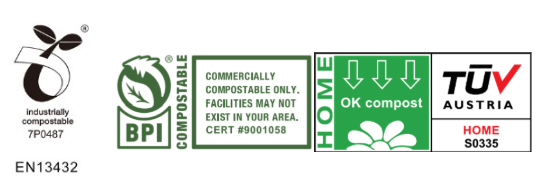
A bag that passes BPI (US) does not automatically satisfy EN 13432 (EU), and a bag with OK Compost INDUSTRIAL cannot legally be labeled "home compostable" in France without NF T 51-800. This guide explains what procurement managers in Lyon or compliance officers in Los Angeles will actually ask for before they sign a PO.
Who this is for: B2B suppliers, procurement managers, compliance teams — anyone who needs to answer "is this bag really compostable?" with evidence that holds up under audit.
2. The Regulatory Floor
In Europe, PPWR 2025/40 turned voluntary claims into legal requirements. In the US, the FTC Green Guides combined with state-level laws raised the stakes from reputational risk to enforcement action.
EU: PPWR 2025/40
Enforcement begins August 12, 2026.
- Article 5 — PFAS ban: Food-contact packaging with intentionally-added PFAS prohibited from August 2026. Limits: ≤25 ppb single PFAS, ≤250 ppb total PFAS, ≤50 ppm total fluorine.
- Article 6: All packaging must achieve ≥70% recyclability (Grade C) by 2030. Certified compostable packaging per EN 13432 is recognized as an organic-recycling compliance track.
- Article 9: By February 2028, tea/coffee bags, coffee pods, and fruit/vegetable labels must be compostable. Bio-waste collection bags and lightweight carrier bags receive single-use plastic ban exemptions if certified.
- EPR: Certified compostable packaging qualifies for reduced Extended Producer Responsibility fees — typically 30-50% lower.
US: FTC Green Guides & State Laws
- §260.7 — Compostable Claims: Must be substantiated by competent and reliable scientific evidence. BPI certification is the accepted standard.
- Qualification required: If only industrial compostable, must disclose that limitation prominently.
- California SB 54 (2022): 65% plastic-waste reduction by 2032. Products labeled "compostable" must meet ASTM D6400/D6868. Regulations approved May 2026 with June 1 registration deadline.
- PFAS: 12 states restrict PFAS in food-contact packaging. BPI's 2020 PFAS ban (<100 ppm total organic fluorine) inherently satisfies state requirements.
3. The Certification Ecosystem
Four layers: Accredited Lab → Test Standard → Certification Body → Certification Logo. Same lab can serve multiple certifiers; same certifier can use multiple labs. The standard is the anchor.
| Body | Role | Region |
|---|---|---|
| CEN | Publishes EN 13432 | EU |
| ASTM International | Publishes D6400 / D6868 | US / Global |
| TÜV Austria | Issues OK Compost marks | EU / Global |
| DIN CERTCO | Issues DIN-Geprüft & Seedling; BPI technical reviewer | EU / Global |
| BPI | Certification program for North America | US / Canada |
| CMA | Field disintegration testing | US / Canada |
4. European Certifications
EU EN 13432 — The Legal Baseline
The harmonized European standard: ≥90% biodegradation in 180 days at 58±2°C, disintegration ≤10% >2mm within 12 weeks, ecotoxicity pass, heavy metals below Directive 94/62/EC limits. Certificates valid 3 years with annual surveillance. PPWR PFAS limits apply from August 2026.
EU OK Compost INDUSTRIAL
Issued by TÜV Austria. EN 13432 plus field disintegration testing at an operating composting facility. Annual surveillance audits. The certification Tesco, Lidl, Aldi, and Carrefour look for. Each SKU requires separate certification.
EU OK Compost HOME
≥90% biodegradation within 12 months at ~25°C. The harder test. A product with HOME automatically meets industrial standards. The reverse is not true. PPWR labeling rules (2028) will make HOME the de facto requirement for consumer-facing compostable claims.
EU DIN-Geprüft & Seedling
Two marks, one certifier (DIN CERTCO). DIN-Geprüft dominates German-speaking markets. The Seedling logo is the most consumer-facing mark in Europe. DIN CERTCO is also the technical reviewer for BPI in North America.
EU NF T 51-800 (France)
French home-compostability standard. Legal requirement for bio-waste collection bags under Loi AGEC since January 2024. ≥90% biodegradation at ≤30°C within 12 months. BPI's Home Compostability Program (2025) is based on this standard.
5. North American Certifications
US ASTM D6400 / D6868
D6400 for plastics: ≥90% biodegradation in 180 days at 58°C, disintegration <2mm within 84 days. D6868 for coated paper/fiber. D8410 (2022) for uncoated cellulosic fiber. Certification is thickness-specific — a 1.0-mil certificate does not cover a 1.5-mil bag.
US BPI Certification
Operating 25+ years. PFAS-free since January 2020 (<100 ppm total organic fluorine). Searchable public database at bpiworld.org — no listing = not certified in the buyer's eyes. BPI reviews every product artwork before certification. Home Compostability Program launched 2025.
US CMA Field Testing
Field disintegration testing at operating composting facilities — CMA-W (windrow), CMA-ASP (aerated static pile), CMA-IS (in-vessel). Ann Arbor, MI requires CMA-W in addition to BPI since 2024. Canada's Compost Council is building a Canadian CMA program.
6. UK & International
UK REAL CMCS
Post-Brexit UK certification through Renewable Energy Assurance Limited. Based on BS EN 13432 / BS EN 14995. For home compost: NF T 51-800 or AS 5810.
Global ISO 17088 / 18606
International framework standards. Not certification programs — nobody's compliance team asks for "ISO 17088 certification." Useful as harmonization references only.
7. Comparison Table
| Certification | Region | Type | Biodegradation | Disintegration | PFAS |
|---|---|---|---|---|---|
| EN 13432 | EU | Industrial | ≥90% / 180d | ≤10% / 12wk | PPWR overlay |
| OK Compost IND | EU | Industrial | ≥90% / 180d | ≤10% / 90d | Yes |
| OK Compost HOME | EU | Home | ≥90% / 12mo | ≤10% / 6mo | Yes |
| NF T 51-800 | France | Home | ≥90% / 12mo | ≤10% / 180d | Yes |
| BPI Certification | US/CA | Industrial | ≥90% / 180d | <2mm / 84d | <100ppm |
| CMA | US/CA | Field | Lab+field | Field cycle | BPI prereq |
8. Buyer's Verification Checklist
9. Greenwashing Traps
10. What's Coming
- PPWR enforcement — August 2026. PFAS restrictions, recyclability requirements take effect.
- California SB 54 full implementation — January 2027. Producer fees begin. First enforcement actions expected late 2027.
- FTC Green Guides revision — 2026-2027. Higher substantiation standards expected.
- CMA + BPI dual certification spreading. Ann Arbor precedent being watched by other municipalities.
- EU Digital Product Passports — 2027-2028. QR codes linking to full lifecycle data.
- Canada field testing requirement. CMA / Compost Council of Canada program in development.
